
Players who value session length over bonus frequency and want the 96.51% figure untouched.
On this page
- The bonus buy in seven numbers
- From the Buy button to the last tumble
- Buying the bonus: four actions
- Natural play, Ante Bet and bonus buy compared
- RTP builds and the feature-buy figure
- Price, buys and expected return tables
- What 100 bonus buys are expected to return
- Where the Buy button exists, is hidden or is illegal
- Sweet Bonanza 1000 compared
- Sizing the stake for a bad run
- The free demo and its RTP caveat
- Verdict
- Frequently asked questions
The Sweet Bonanza Bonus Buy in Seven Numbers
Buying the bonus in Sweet Bonanza costs 100× the current total bet, awards 10 free spins with candy bomb multipliers between 2× and 100×, and runs on a base return of 96.51% in the standard build; the maximum win from any single buy is 21,100× the bet. The table below is the full specification of the feature as it appears in the game rules; every later section expands one of these rows, including the operator RTP versions that change the second-to-last line.
| Parameter | Value |
|---|---|
| Buy price | 100× total bet |
| Stake range | $0.20 to $100 per spin, so a buy costs $20 to $10,000 |
| Free spins awarded | 10 |
| Retrigger | +5 spins for every 3 or more lollipop scatters inside the round |
| Multiplier bombs | 2× to 100×, all visible bombs summed before applying |
| Base RTP | 96.51% in the standard build; operator configurations down to 95.45% exist |
| Max win | 21,100× total bet, including a bought bonus |
From the Buy Button to the Last Tumble: The Feature Step by Step
Sweet Bonanza runs on a 6×5 pays-anywhere grid where eight or more matching symbols pay regardless of position and every win removes itself through the tumble feature. The bonus buy does not change that engine; it skips the base game entirely and forces the scatter trigger on the next spin. The four stages below are the only things the player interacts with between confirming the purchase and seeing the final balance.
1 · Set the stake: $0.20 to $100→
2 · Buy: 100× the stake→
3 · 4+ scatters land, guaranteed next spin→
4 · 10 free spins, bombs 2× to 100×
Why the price is always exactly 100 times the bet
Pragmatic Play fixes the Sweet Bonanza bonus buy at 100× total bet in every market where the feature is enabled, so the minimum bonus buy price is $20 at the floor stake of $0.20 and the maximum is $10,000 at the $100 ceiling. The price scales linearly and does not round, which makes budgeting simpler than in slots whose buy multiplier changes with the stake or the chosen feature.
| Stake per spin | Buy price |
|---|---|
| $0.20 | $20 |
| $1.00 | $100 |
| $5.00 | $500 |
The guaranteed scatter spin and what it awards
After confirmation the reels spin once at the chosen stake and land at least four lollipop scatters. That spin still pays scatter wins and any eight-symbol clusters it happens to form, then the free spins round opens with 10 spins. In the editorial test sessions the bought trigger landed four scatters on every purchase; a natural trigger can land five or six lollipops for 15 or 20 spins, so the buy is a flat 10-spin product rather than a lottery on the entry spin.
Candy bombs: the multipliers that decide the outcome
Rainbow candy bombs appear only during free spins and carry random values from 2× to 100×. Every bomb visible when a tumble sequence ends is added together and the sum multiplies the combined win of that sequence; a 20×, a 50× and a 10× bomb on the same screen multiply the win by 80×. A bomb with no eight-symbol win beside it contributes nothing, which is why a round can show a 100× bomb and still return less than the price. The 21,100× maximum win is reached when large bomb sums meet long tumble chains of the red heart candy, and a bought round is eligible for the full cap.
Retriggers inside a bought round
Three or more lollipops on any free spin add five further spins, with no limit on how many times this can happen. Retriggers are the mechanism that stretches a 10-spin purchase into 20 or 30 spins and gives the bomb symbols more chances to land on a winning screen; a bought bonus retriggers at the same rate as a natural one because the free spins reel set is identical.
Buying the Bonus: Four Actions and One Reason the Button Goes Grey
The purchase takes under a minute. The sequence is the same on desktop and mobile, with the Buy Free Spins panel sitting to the left of the reels on wide screens and above them on phones. A greyed-out button is almost always the Ante Bet toggle, not a missing feature; a fully absent button is a market or operator setting covered in the availability section.
- Set the total bet
Use the plus and minus controls to pick a stake between $0.20 and $100. The figure shown in the Buy Free Spins panel updates to 100× this value immediately.
- Switch the Ante Bet off if the button is grey
The game does not allow both modes at once. With the Ante Bet on, the buy button is disabled; turning the toggle off restores it without changing the stake.
- Open the panel and check the price
Click Buy Free Spins. The confirmation screen repeats the exact cost, $20 at a $0.20 stake, and the balance after the purchase.
- Confirm and play the round
The next spin lands four or more lollipops and the 10 free spins begin. The round runs to completion with no further input needed.
The same sequence works in demo mode, which is the safest way to see the purchase flow before committing real money.
Three Routes Into the Same Free Spins Round, Priced Side by Side
Every Sweet Bonanza bonus is the same 10-spin round with the same bombs; what differs is how much stake the player burns to reach it and how much of the game’s return is preserved on the way. Natural play reaches the round roughly once in 200 spins. The Ante Bet raises each spin to 1.25× the base stake and doubles the number of scatters on the reels, which brings the trigger to roughly once in 100 to 150 spins in extended test play. The bonus buy replaces the wait with a single 100× payment.
- 100×Bonus buy — 100× the bet once, one spin to the bonus, no base-game wins on the way
- ~125–190×Ante Bet — 1.25× the bet per spin, about 100–150 spins to a bonus, RTP effectively unchanged
- ~200×Natural trigger — 1.00× the bet per spin, about 200 spins to a bonus, 96.51% base build
| Criterion | Natural play | Ante Bet | Bonus buy |
|---|---|---|---|
| Cost per spin | $1.00 | $1.25 | n/a |
| Spins to a bonus (approx.) | ~200 | ~100 to 150 | 1 |
| Stake spent per bonus (approx.) | ~$200 minus base-game wins | ~$125 to $190 minus base-game wins | $100 flat |
| RTP | 96.51% base build | ~96.48%, effectively unchanged | Separate feature-buy figure, close to base |
| Variance | Spread across hundreds of spins | Spread across ~100 spins | Concentrated in one decision |
| Base-game wins on the way | Yes | Yes | None |
Read in cash terms, the buy is the cheapest ticket into the round: $100 against an average of $125 to $200 of stake by the other two routes, before base-game wins are netted off. Read in return terms, the Ante Bet is the safer choice because it keeps the published RTP and keeps a session alive for a hundred spins of tumbles and small clusters. The buy wins on time and loses on smoothness; the expected-return section puts a number on that trade.
Players who want bonuses twice as often for a 25% surcharge, with the RTP effectively intact.
Players with limited time, a bankroll that covers several buys, and tolerance for a round that returns under 20×.
Which 96.51% Is the Player Actually Getting? RTP Builds and the Feature-Buy Figure
Sweet Bonanza is supplied to operators in more than one mathematical build. The standard version returns 96.51% over the long run; a lower build set at 95.45% is live at a number of casinos, and lower configurations exist. The demo always runs the top build, so the only reliable check is the information panel in real-money mode. Pragmatic Play lists a separate theoretical return for the feature buy; in the 96.51% build it sits within a few tenths of the base figure, so the choice of operator build matters far more to a bonus buyer than the choice between buying and waiting.
| RTP build | House edge | Spins per $100 at $1 | Bonus buys per $1,000 at $1 before edge |
|---|---|---|---|
| 96.51% | 3.49% | 2,865 | 10, expected return $965 |
| 95.45% | 4.55% | 2,198 | 10, expected return $955 |
| Lower builds | Exist; verify in the game info panel before buying | ||
The gap looks small on paper and is not. At $1 per spin the same $100 lasts 2,865 spins on the top build and 2,198 on the 95.45% build, a 30% shorter session, and the same compression applies to a run of bonus buys. Volatility is rated medium to high by the provider, which in practice means long stretches of sub-cost bonuses punctuated by rounds in the hundreds of x; the buy does not raise the volatility of the round itself, it removes the base-game cushion that would otherwise absorb some of it.
How to check the RTP version in 30 seconds
- Log in and open Sweet Bonanza in real-money mode, not the demo.
- Open the information panel, the “i” icon beside the settings cog.
- Scroll to the rules page headed “RTP”. The figure shown is the build the operator runs: 96.51% is the top version, 95.45% or lower means a reduced build.
Price, Buys and Expected Return for Any Stake and Bankroll
The tables convert a stake and a bankroll into the cost of one buy, the number of buys the bankroll covers and the theoretical return at each RTP build. The return figures are long-run averages over thousands of rounds and describe the price of the feature, not the result of the next purchase. Expected return per buy is the price multiplied by the build’s RTP; expected cost is the difference.
| Stake per spin | Buy price | Expected return, 96.51% | Expected cost, 96.51% | Expected return, 95.45% | Expected cost, 95.45% |
|---|---|---|---|---|---|
| $0.20 | $20.00 | $19.30 | $0.70 | $19.09 | $0.91 |
| $0.50 | $50.00 | $48.25 | $1.75 | $47.73 | $2.27 |
| $1.00 | $100.00 | $96.51 | $3.49 | $95.45 | $4.55 |
| $2.00 | $200.00 | $193.02 | $6.98 | $190.90 | $9.10 |
| $5.00 | $500.00 | $482.55 | $17.45 | $477.25 | $22.75 |
| $10.00 | $1,000.00 | $965.10 | $34.90 | $954.50 | $45.50 |
| $20.00 | $2,000.00 | $1,930.20 | $69.80 | $1,909.00 | $91.00 |
| $50.00 | $5,000.00 | $4,825.50 | $174.50 | $4,772.50 | $227.50 |
| $100.00 | $10,000.00 | $9,651.00 | $349.00 | $9,545.00 | $455.00 |
How many buys a bankroll covers, and what the session is expected to cost
At a $1 stake each buy costs $100, so the number of buys is the bankroll divided by 100, rounded down; the expected total is that count multiplied by the expected return per buy. The $500 row is the default of the planner in the source material: five buys, $482.55 expected back, $17.45 expected cost on the standard build.
| Bankroll for buys | Buys covered | Expected total, 96.51% | Expected cost, 96.51% | Expected total, 95.45% | Expected cost, 95.45% |
|---|---|---|---|---|---|
| $100 | 1 | $96.51 | $3.49 | $95.45 | $4.55 |
| $250 | 2 | $193.02 | $6.98 | $190.90 | $9.10 |
| $500 | 5 | $482.55 | $17.45 | $477.25 | $22.75 |
| $1,000 | 10 | $965.10 | $34.90 | $954.50 | $45.50 |
| $2,000 | 20 | $1,930.20 | $69.80 | $1,909.00 | $91.00 |
| $5,000 | 50 | $4,825.50 | $174.50 | $4,772.50 | $227.50 |
| Stake | Bankroll | Buy price | Buys covered | Expected total | Expected cost |
|---|---|---|---|---|---|
| $0.20 | $100 | $20 | 5 | $96.51 | $3.49 |
| $0.50 | $500 | $50 | 10 | $482.55 | $17.45 |
| $2.00 | $500 | $200 | 2 | $386.04 | $13.96 |
| $5.00 | $1,000 | $500 | 2 | $965.10 | $34.90 |
For information only. Expected values are theoretical averages and do not predict any individual round.
What 100 Bonus Buys Are Expected to Return, and How Wide the Spread Is
The expected-value arithmetic for a run of purchases is short. At a $1 stake, 100 buys cost $10,000. On the 96.51% build the theoretical return is $9,651, a cost of $349 for 100 rounds; on the 95.45% build it is $9,545, a cost of $455. The shape around that average is what the volatility rating describes: a medium-to-high rated round returns less than its price in the majority of cases and recovers the average through a minority of rounds that pay several hundred x, with the 21,100× cap sitting far out in the tail. The figures below are derived from the published return, not from a recorded session; the editorial team’s observed log is appended to this section after each verification cycle and replaces the modelled column.
| Measure | 96.51% build | 95.45% build |
|---|---|---|
| Total cost | $10,000 | $10,000 |
| Expected return | $9,651 | $9,545 |
| Expected cost of 100 rounds | $349 | $455 |
| Expected return per buy | 96.51× | 95.45× |
| Break-even round | 100× the stake | |
| Maximum single round | 21,100× | |
Two consequences follow for anyone planning a session of buys. First, a run of ten purchases that all return under cost is an ordinary outcome for this volatility, not evidence of a broken game. Second, the difference between builds compounds: over 100 buys the reduced build costs about $106 more at a $1 stake, which is more than one entire buy. The Sweet Bonanza 1000 figures push both the ceiling and the spread considerably further.
Markets Where the Buy Button Exists, Is Hidden, or Is Illegal
A missing Buy Free Spins button has three possible causes, and only one of them is fixable from the player’s side. The UK Gambling Commission banned feature purchases in 2019, so no UKGC-licensed casino shows the button. In several other regulated markets the regulator permits the feature but the operator chooses its own build, and some switch it off. Finally, many casinos require identity verification before any real-money feature is available, and an unverified account can see the slot but not the buy option. The demo displays the button everywhere, including in markets where the live game cannot offer it.
| Market type | Bonus buy status | Why |
|---|---|---|
| UK-licensed casinos | Not available | UKGC prohibits feature purchases |
| European regulated markets | Operator-dependent | Local rules allow it; the casino picks the build |
| International and crypto casinos | Usually available | Provider default build with the buy enabled |
| US sweepstakes casinos | Available in most states | Gold Coin and Sweeps Coin model; a 1 SC stake makes the buy 100 SC, with state-level exclusions |
| US state-licensed casinos | Varies by state and operator | Regulators such as the New Jersey and Michigan boards licence the game; the buy is an operator setting |
Button missing? Three checks in order
- Ante Bet toggle: switch it off, the button returns if it was only disabled.
- Account status: complete verification, since unverified accounts are often restricted from real-money features.
- Licence: check which regulator the casino holds a licence from; under a UKGC licence the feature cannot be enabled at all.
Where to play Sweet Bonanza with the bonus buy therefore depends on licence before brand. International casinos running the provider’s default build and US sweepstakes platforms offering the game for Sweeps Coins are the two environments where the feature is reliably present; the player should confirm both the build on the rules page and the local legality of playing before committing a bankroll.
Buying the Bonus in Sweet Bonanza 1000: Same Price, a 500× Super Option and Ten Times the Bomb Ceiling
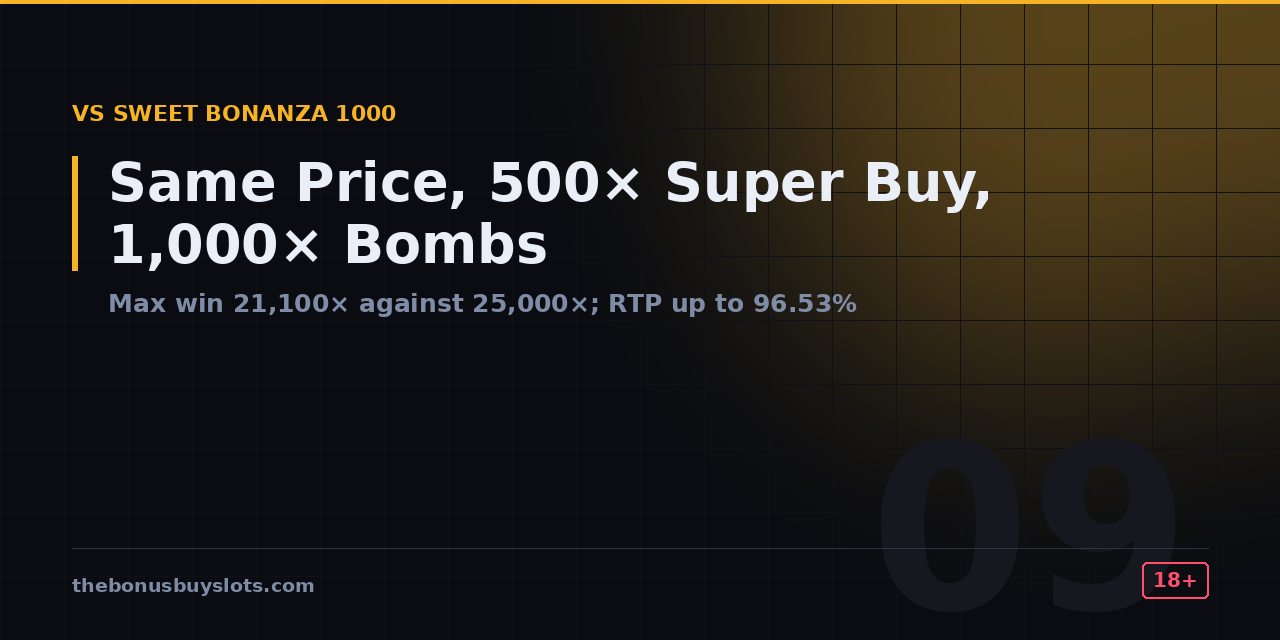
Sweet Bonanza 1000 is a separate game released by Pragmatic Play on 3 June 2024, not a setting inside the original. It keeps the 6×5 pays-anywhere grid, the tumble feature and the 100× bonus buy, and adds a second purchase: Super Free Spins at 500× the bet, in which every candy bomb carries a minimum value of 20×. The multiplier ceiling per bomb rises from 100× to 1,000× and the maximum win from 21,100× to 25,000×, with a listed return of up to 96.53% and a top stake of 300.
Sweet Bonanza
| Standard buy | 100× |
|---|---|
| Super buy | None |
| Bomb range | 2× to 100× |
| Max win | 21,100× |
| RTP, top build | 96.51% |
| Volatility | Medium to high |
Sweet Bonanza 1000
| Standard buy | 100× |
|---|---|
| Super buy | 500×, min bomb 20× |
| Bomb range | 2× to 1,000× |
| Max win | 25,000× |
| RTP, top build | Up to 96.53% |
| Volatility | High |
The practical difference is distribution rather than price. The 1000 version returns the same long-run percentage but packs more of it into rare 1,000× bombs, so a standard 100× buy produces more sub-cost rounds between the large ones, and the 500× super buy raises the cost of each attempt fivefold in exchange for a guaranteed bomb floor. Players who prefer the original’s smoother 2× to 100× spread have no reason to switch; players chasing the higher cap pay for it in variance.
Sizing the Stake So One Bad Run of Buys Is Survivable
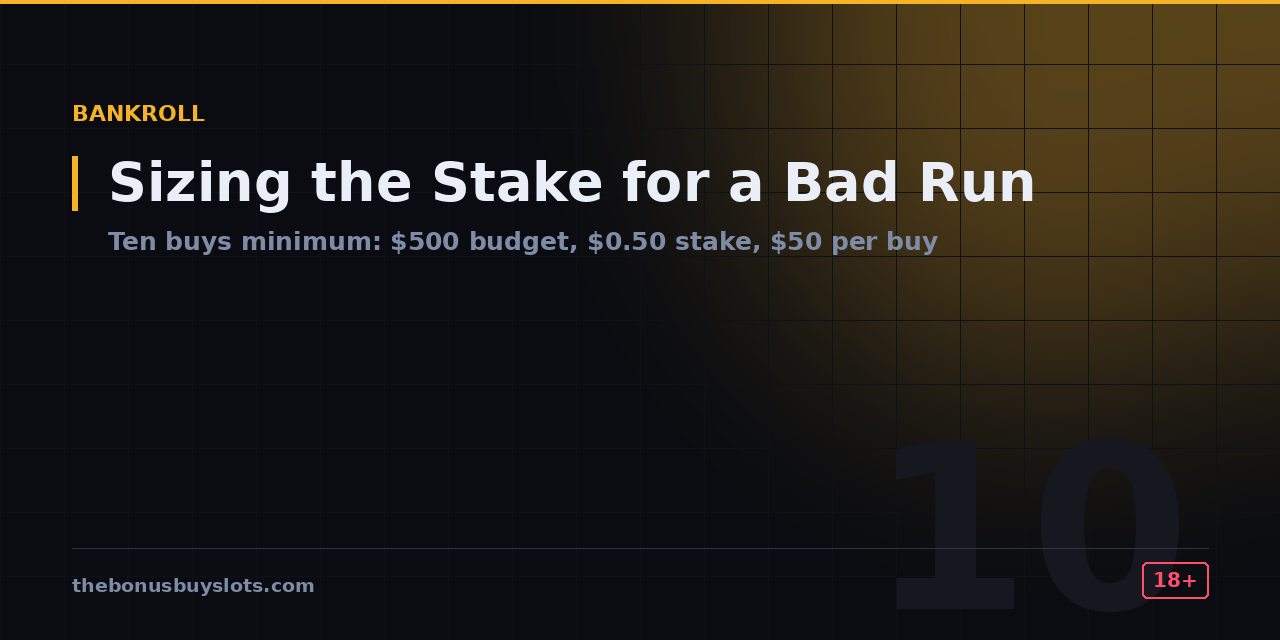
Streamer sessions that put an entire balance into one Sweet Bonanza bonus buy make for clips, not for a bankroll plan; at 96.51% the feature costs money on average and its variance makes strings of sub-cost rounds routine. Three rules keep the purchase inside a budget. First, size the stake so the buy price is no more than a tenth of the money set aside for buys, which at $500 means a $0.50 stake and a $50 buy. Second, keep the stake flat across the session rather than raising it after a losing round. Third, set the stop-loss before the first purchase and treat it as fixed.
Ten buys minimum
Buy price at most 10% of the buy budget. $500 budget, $0.50 stake, $50 per buy.
Flat stake
The same stake for every purchase. Raising it after a loss turns variance into a loss-chasing loop.
Stop-loss first
Decide the exit figure before the first buy, and use the casino’s deposit limit and self-exclusion tools to enforce it.
BeGambleAwareInformation and support in the UK. begambleaware.org
GamCareConfidential support for the UK. gamcare.org.uk
National Council on Problem GamblingUnited States helpline, confidential, 24/7: 1-800-GAMBLER.
18+. Feature purchases accelerate losses when chased.
The Free Demo: Every Feature, No Download, One Caveat on RTP
The Sweet Bonanza demo runs on virtual credits with no registration or download and includes the full bonus buy, so the price scaling, the forced scatter spin and the bomb arithmetic can all be checked without risk. The one thing it cannot show is the operator’s build: free play always loads the 96.51% version, so the figure on the demo’s rules page says nothing about the casino where the player eventually deposits.
Sweet Bonanza free demo
Back to contents
Pragmatic Play’s demo client (game symbol vs20fruitsw) is available at operator sites and the provider’s own demo catalogue. It loads the 96.51% build on virtual credits; 18+, demo play awards no real money.
Verdict: A Fairly Priced Shortcut That Only Pays for the Right Bankroll
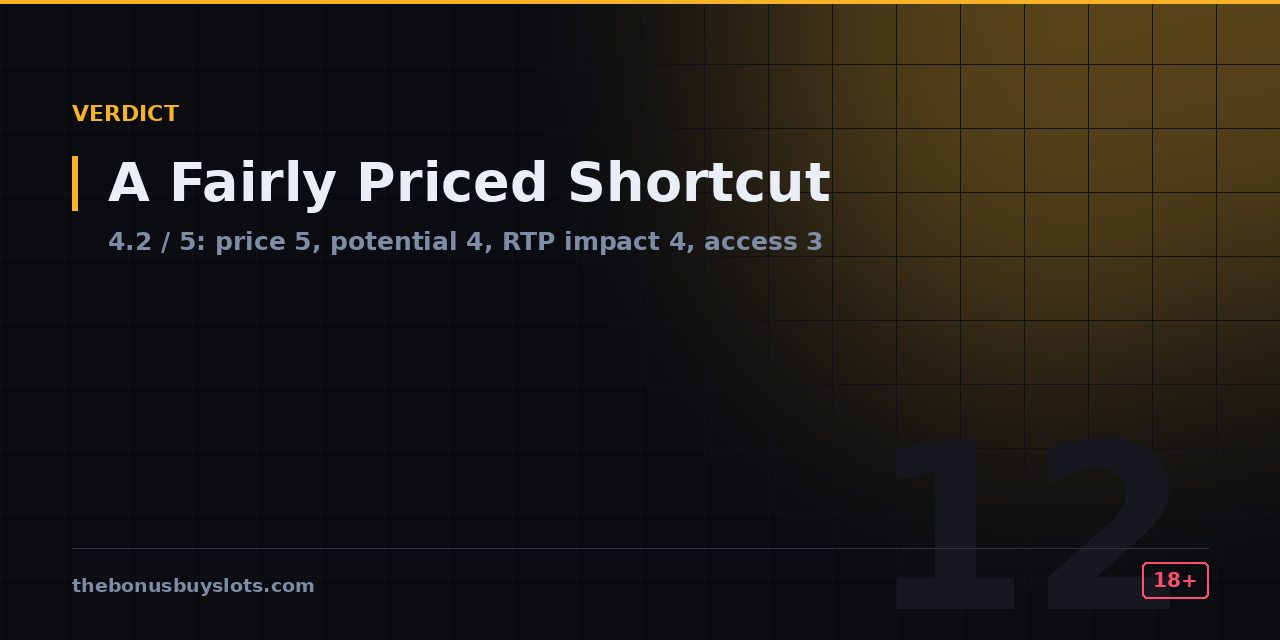
The Sweet Bonanza bonus buy is one of the more transparent feature purchases in the Pragmatic Play catalogue: a fixed 100× price, a return close to the published base figure and a round identical to the natural one. It makes sense for a player with limited time, a budget that covers at least ten purchases and no objection to rounds that return under 20×. It makes less sense for a player who wants the full 96.51% and a long session, for whom the Ante Bet reaches the same round twice as often at a 25% surcharge. The build the casino runs matters more than either choice.
4.2/ 5
- Price transparency5 / 5
- Bonus potential4 / 5
- RTP impact4 / 5
- Accessibility across markets3 / 5
Pros
- Fixed 100× price at every stake
- Feature return close to the base 96.51%
- Bought round eligible for the full 21,100× cap
Cons
- Unavailable under UKGC licences and at some operators
- No base-game wins to soften variance
- Reduced 95.45% builds raise the cost of every buy
Frequently Asked Questions
Cost and value
How much does the Sweet Bonanza bonus buy cost?
100× the total bet. At the $0.20 minimum stake the buy costs $20, at $1 it costs $100 and at the $100 maximum it costs $10,000. The price is fixed in every build and market where the feature is enabled, and it purchases 10 free spins triggered on the next spin. See the specification table.
Is the Sweet Bonanza bonus buy worth it?
At a 96.51% return the buy costs about 3.5× the stake per round on average and is the cheapest route into the free spins in cash terms, but it concentrates all of the game’s variance into one decision. It suits players with limited time and a budget covering ten or more purchases; players who want session length are better served by the Ante Bet. The verdict sets out the criteria.
Does the bonus buy change the RTP?
Pragmatic Play publishes a separate theoretical return for the feature buy, and in the standard 96.51% build it sits within a few tenths of the base figure. The larger effect on return comes from the operator’s build: a casino running the 95.45% version applies that reduction to bought rounds as well. Check the figure in the in-game rules panel.
Bonus buy or Ante Bet: which reaches the free spins more cheaply?
Per bonus, the buy: $100 flat at a $1 stake, against roughly $125 to $190 of stake through the Ante Bet and about $200 through natural play, before base-game wins are deducted. Per unit of return, the Ante Bet: it keeps the RTP effectively unchanged and spreads risk over about a hundred spins. The comparison table shows all three routes.
Availability and legality
Why can’t the bonus be bought, or why is the button grey?
A grey button means the Ante Bet is switched on; the two modes cannot run together, and turning the toggle off restores the buy. A button that is absent altogether means the casino’s licence or settings exclude the feature, as under every UK Gambling Commission licence, or the account has not completed verification. The availability section lists the markets.
Is buying bonuses legal?
Legality follows the licence the casino holds, not the game. The UK Gambling Commission prohibits feature purchases outright; most other regulators permit them and leave the decision to the operator; US sweepstakes platforms offer the buy for Sweeps Coins subject to state exclusions. Playing at a casino that is lawful in the player’s own jurisdiction is the only condition that matters.
Returns and bankroll
How often does a bonus buy pay back 100×?
Less than half the time, which is what a medium-to-high volatility rating with a 96.51% average implies: the majority of rounds return below the 100× price and the average is restored by a minority paying several hundred x, with 21,100× as the cap. The expected-return section works through the arithmetic for 100 purchases at each RTP build.
How many bonus buys should a bankroll cover?
At least ten, so that a normal run of sub-cost rounds does not end the session. That means setting the stake so the buy price is no more than a tenth of the money allocated to buys: a $500 budget supports a $0.50 stake and a $50 buy. The cost tables give the figure for common stakes and bankrolls, and the bankroll rules cover flat staking and stop-losses.